

Email still drives reliable revenue for eCommerce when you treat it as a performance channel, not a batch-and-blast megaphone. Email marketing optimisation gives you a clear way to turn traffic into customers and customers into repeat buyers.
To compete with larger brands, you need email that works harder: smarter segmentation, better timing, and message flows that push each customer to a clear next step. That is where a focused ecommerce email marketing approach wins.
What is ecommerce email marketing?
If we choose to describe what email marketing optimization really is, it can be described as follows: The process of continuously improving your email campaigns to increase open rates, click-through rates, conversions, and ROI by refining every element of an email based on data, testing, and user behavior.
Key Components of Email Marketing Optimisation
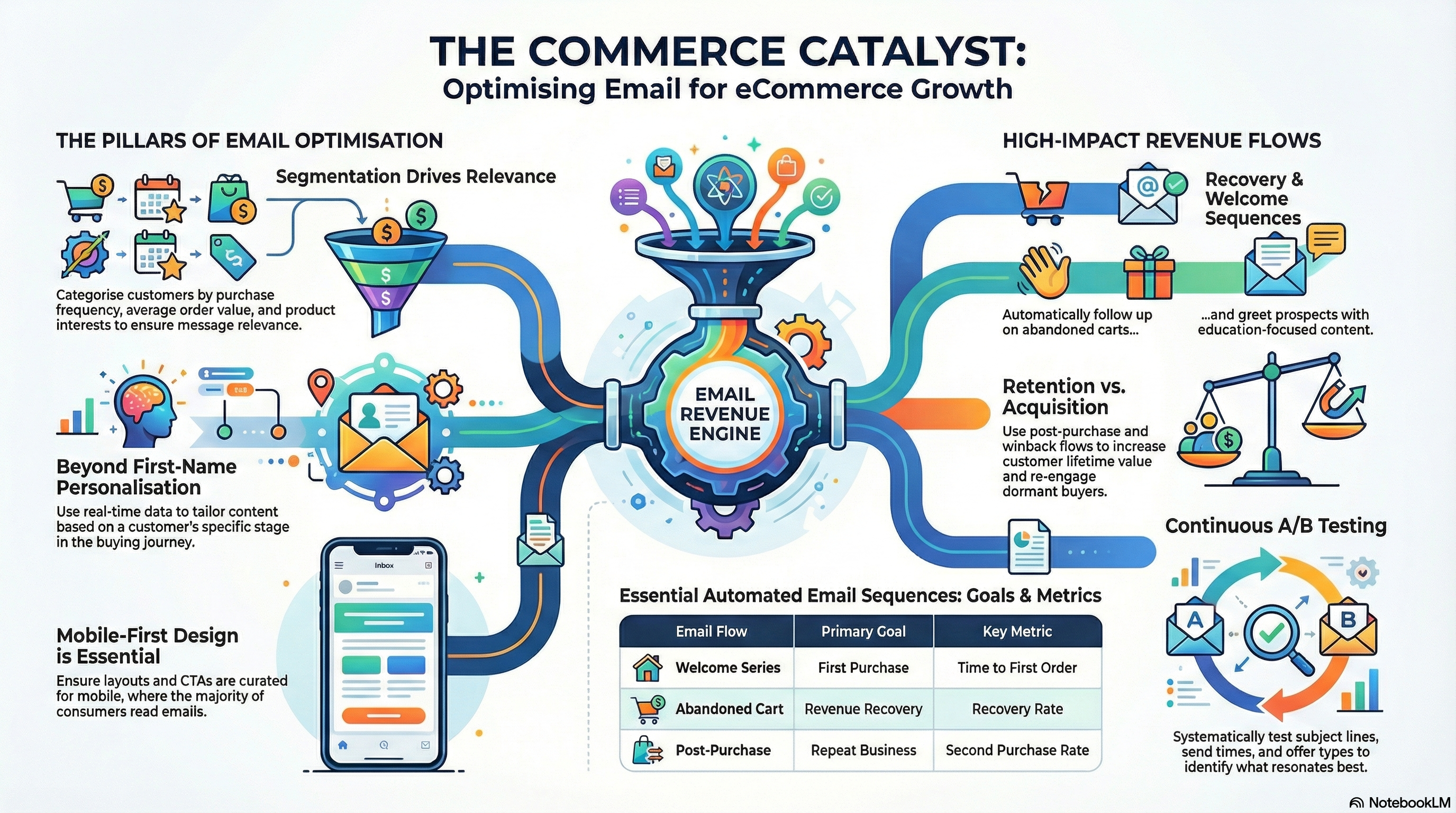
Audience Segmentation Robotic and animated emails sent to consumers, which are clichéd and generic, usually perform poorly, as they do not solve any specific problems, nor do they seem to connect with the consumer. Segmentation ensures relevance, and relevance drives conversion.
Personalisation Personalization goes beyond just the first-name basis. The email that is to be generated should be tailored in such a manner that it speaks to the customer in a way that makes them want to open the mail and then go from call to conversion in a smooth manner.
Subject Line Optimisation Crafting compelling, concise, and curiosity-driven subject lines to improve open rates.
Content Optimisation Enhancing email copy, visuals, layout, and CTA placement is crucial to encourage clicks and actions.
Mobile Optimisation Most people use their mobile phones to open and read the email; make sure that it is curated well from your side.
Performance Tracking & Analytics Monitoring Key indices like open rate, CTR, bounce rate, conversions, and unsubscribe rate to guide towards better performance and improved growth.
Why email marketing matters in ecommerce
Paid ads grow more expensive. Algorithms shift. Email gives you a direct line to customers you own. You are not renting reach from a platform each time you want to sell.
Strong email programs drive sales in three ways:
• Convert more of your existing traffic
• Increase average order value
• Increase purchase frequency
Effective ecommerce email marketing means you treat each message as part of a larger, optimized funnel.
Benefits of launching ecommerce email marketing campaigns
When you invest in email marketing optimisation, you create a scalable system that supports your revenue targets month after month.
1. Higher conversion rates from existing traffic
Most visitors leave without buying. When you connect segmentation with intent based flows, your ecommerce email marketing starts to feel personal and timely, which leads to more sales from the same list size.
2. Better customer lifetime value
You guide first time buyers toward a second order. You introduce higher margin products at the right moment. You re-engage dormant customers before they lapse for good.
What are common types of ecommerce emails?
1. Welcome series
Send them customized welcoming emails based on their profile.
2. Abandoned cart and browse recovery
Follow up on every cart abandonment.
3. Post purchase and upsell flows
These processes are initiated following the completion of an order. Make sure to ask for reviews about the product and purchase experience.
4. Winback and re engagement
This process is triggered when customers cease their purchases for a specific duration. You remind them why they liked you in the first place and present a relevant offer.
5. Promotional and seasonal campaigns
There are planned campaigns for new product drops, sales, and seasonal events. These ride demand spikes. Robotic and animated emails sent to consumers, which are clichéd and generic, usually perform poorly, as they do not solve any specific problems, nor do they seem to connect with the consumer. Segmentation ensures relevance, and relevance drives conversion.
How can ecommerce businesses personalize their emails?
Use behavior and purchase data
Strong personalization starts with data. At minimum, you segment by:
• Product categories viewed or purchased
• Purchase frequency and recency
• Average order value
• Location when it affects inventory or shipping
Segment by lifecycle stage
Design content for where someone sits in the journey:
• Prospects: focus on value propositions, social proof, and education
• First time buyers: focus on onboarding and cross sell
• High value customers: focus on exclusivity and early access
• At risk customers: focus on tailored offers and friction removal
What are key metrics to track in ecommerce email marketing?
Core engagement metrics
Click through rate: Shows how compelling your content and offers are.
Revenue and conversion metrics
Conversion rate: Percentage of recipients who complete the target action, usually purchase.
Health metrics
Spam complaint rate: Critical for deliverability. Keep this as low as possible.
How can ecommerce email marketing improve customer retention?
Email marketing isn’t just about immediate sales. Optimized strategies also support:
By generating Brand loyalty over due course of time
By increasing the number of repeat purchases
Upselling and cross-selling
Predictable revenue streams
Interactive consumer patterns by customizing the emails in a manner which speaks to the consumers.
By nurturing customers throughout their lifecycle, email becomes a long-term growth channel rather than a short-term promotional tool.
How to measure the success of your email campaigns
1. Define clear goals for each flow and campaign
Each email or sequence needs one primary goal:
• Welcome series: first purchase rate and time to first order
• Abandoned cart: recovered revenue and recovery rate
• Post purchase: second purchase rate and average order value
• Winback: reactivation rate and recovered revenue
2. Run structured A/B tests
Test one variable at a time:
• Subject lines and preview text
• Send time and frequency
• Offer types, such as percentage off, free shipping, or bundle deals
• Product recommendation logic
3. Track email impact on whole business performance
Align metrics with your broader eCommerce KPIs:
• Percentage of total revenue from email
• New customer acquisition from email
• Change in customer lifetime value after major email changes
Where CV3 fits into your email marketing optimisation strategy
To reach strong performance, you need your store, data, and email working in sync. CV3 helps mid market and growth focused eCommerce brands connect their storefronts with marketing and data systems so email works off clean, real time information.
With CV3, you support your email strategy through:
• Unified product and customer data that feed precise segments
• Stable integrations with your email platform for reliable triggers
• Support from experts who understand performance driven ecommerce email marketing, not only templates
If you want email marketing optimisation that converts more of your traffic and lifts repeat revenue, talk to CV3 and build an email ready commerce foundation that keeps pace with your goals.

