
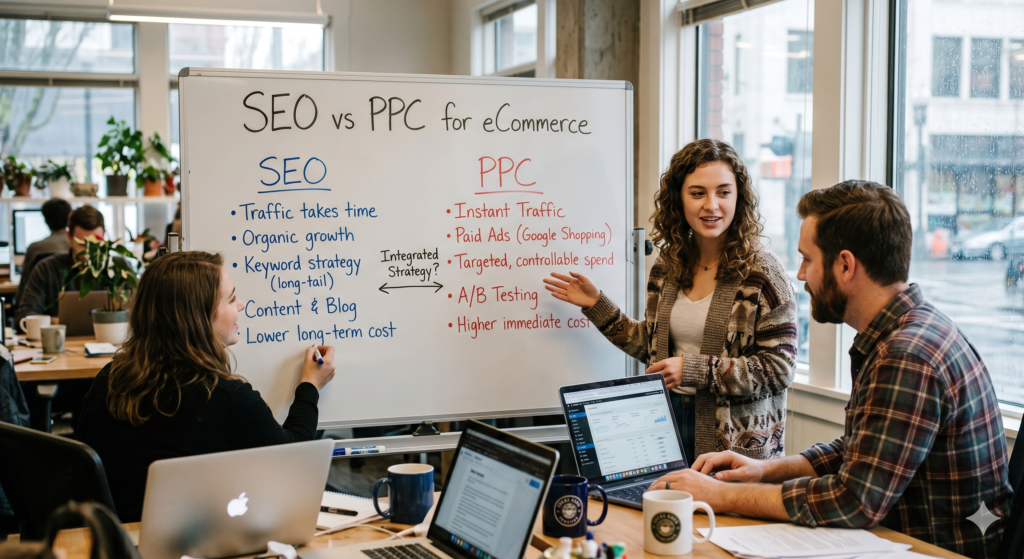
The SEO vs PPC debate has been settled by the math. Median SEO ROI sits at 748 percent across industries; median PPC ROI sits at 200 percent. Average organic search delivers leads at $31 each compared to $181 for paid search — a 5.8x cost efficiency gap. SEO conversion rates run 2.81 percent for ecommerce; PPC averages 1.91 percent on Google Ads. 70 percent of marketers rank SEO as their most effective long-term traffic driver. Ecommerce specifically returns 317 percent ROI on SEO investment.
But that’s only half the story. PPC delivers immediate traffic that SEO can’t match for 4 to 12 months. Average ecommerce CPC sits at $1.16 (rising), CPA at $45.27 on Google Ads. 65 percent of high-intent commercial searches result in a paid ad click. New stores need PPC to validate demand before SEO can compound. AI Overviews are compressing organic search real estate, making the SEO investment harder but more valuable. And 23.6 percent of ecommerce traffic still comes from PPC despite the rising costs.
The honest answer in 2026 isn’t “SEO or PPC” — it’s “which one first, when do I add the other, and how do I sequence the investment to maximize ROI.” This guide walks through the decision framework for ecommerce store owners weighing where to put their next marketing dollar. Cost math, timeline expectations, ROI realities, stage-based recommendations, and how to integrate both for compounding returns.
Why is the SEO vs PPC question different in 2026 than it used to be?
Three structural shifts have changed how ecommerce brands should think about the channel choice:
- AI Overviews compressing organic real estate — Google’s AI Overviews now appear above traditional rankings for many product queries, reducing organic clicks even for top-ranked pages
- Rising paid CPCs — average ecommerce CPC has climbed steadily, with no sign of reversing as more brands compete for shrinking organic visibility
- AI-driven attribution clarifying multi-channel impact — sophisticated attribution shows SEO often influences conversions before PPC closes the deal, making single-channel ROI numbers misleading
What this means for ecommerce brands:
- The “SEO is free” myth has been definitively retired — SEO is an investment with compounding returns, not zero-cost traffic
- PPC has become more important as organic clicks shrink, and more expensive as competition rises
- The brands winning in 2026 are running both with measurement frameworks that capture cross-channel impact
- Choosing one channel exclusively is increasingly a competitive disadvantage
The right question isn’t which channel is “better” — it’s how to sequence investment between them based on your stage, margins, and growth goals. The brands that figure out sequencing compound; the ones that pick a side without strategy fall behind.
What’s the actual cost difference between SEO and PPC for ecommerce?
Most ecommerce founders dramatically underestimate PPC costs and dramatically overestimate SEO costs. The honest math:
PPC costs (2026 ecommerce averages)
- Average CPC: $1.16 across ecommerce
- Average CPA: $45.27 on Google Ads
- Cost per lead: $181 average (varies $20-$500+ by category)
- Monthly minimum spend for meaningful data: $1,500-$3,000
- Costs scale linearly — double the budget, double the traffic. Stop spending, traffic stops
SEO costs (2026 ecommerce averages)
- Cost per organic lead: $31 (5.8x more efficient than PPC)
- Initial investment: $1,500-$10,000+ monthly for content, technical work, and link-building
- Total time to meaningful results: 4-12 months
- Costs compound — month 12 traffic costs less than month 6 traffic
The compounding difference
PPC is linear: spend $1,000 this month, get traffic. Spend another $1,000 next month, get equivalent traffic. SEO is cumulative: a page ranking in month 6 continues generating traffic in month 12 without additional cost. Over 12-24 months, SEO investment typically delivers 3-5x more traffic per dollar spent than equivalent PPC investment.
The catch: SEO requires patience that ecommerce founders without runway often can’t afford. A new store with $50K monthly target can’t wait 6 months for SEO to compound. PPC fills the gap while SEO builds. For more on this trade-off, see our combining SEO and paid ads guide which covers integration once you have both running.
When does PPC win?
PPC wins for specific use cases that SEO can’t match:
- New product launches — immediate visibility for products that need traction before SEO can rank them
- Time-sensitive promotions — flash sales, holiday campaigns, limited-time offers
- High-intent commercial keywords — 65 percent of high-intent commercial searches result in paid clicks
- Brand defense — preventing competitors from bidding on your brand terms
- Geographic targeting — local store promotions, regional campaigns
- Demand validation — testing whether a product or category has commercial appetite before investing in SEO content
- Inventory clearance — moving specific SKUs quickly with bottom-of-funnel ads
- Seasonal peaks — capturing demand during compressed buying windows
- Markets with low organic difficulty — niches where PPC delivers profitable returns even at average ROAS
The honest case for PPC: it’s the only channel that can deliver meaningful traffic within hours. Every other acquisition channel requires patience that growing brands often don’t have. For more on PPC strategy specifically, see our Google Ads for beginners and shopping ads optimization posts.
When does SEO win?
SEO wins for use cases that compound over time:
- Established product categories — evergreen products that customers search for consistently year after year
- Content-heavy purchase journeys — products where buyers research extensively before purchasing
- Brand-building plays — establishing authority in a category through educational content
- Cost-efficient acquisition at scale — once ranked, organic traffic is dramatically cheaper than paid
- Multi-touch customer journeys — SEO content often drives initial discovery that PPC eventually closes
- Competing against bigger budgets — small brands can outrank large brands on long-tail keywords through topical authority
- Building defensible moats — domain authority and topical rankings are harder for competitors to replicate than ad bidding strategies
- Long-tail capture — long-tail keywords convert 2-3x higher than head terms and PPC often makes them economically unviable
The honest case for SEO: it’s the only channel where every dollar invested becomes more valuable over time. Every PPC click is a one-time payment for traffic that disappears when budget stops. Every SEO investment builds on previous investments. For more on SEO strategy specifically, see our why ecommerce businesses require SEO and how to rank product pages posts.
How should you sequence SEO and PPC by business stage?
The right channel mix depends on stage. Three tiers cover most ecommerce brands.
Starter stage (under $50K monthly revenue)
Recommended split: 70-80 percent PPC, 20-30 percent SEO foundations
- PPC priorities: validate demand, identify converting keywords, generate immediate revenue
- SEO priorities: clean technical foundations, optimized product and category pages, build initial topical authority through content
- Total marketing budget: $1,500-$10,000 monthly
- Timeline expectation: PPC delivers within days, SEO foundation work compounds over 6-12 months
The trap: ignoring SEO entirely while focused on PPC. New stores often skip SEO because they need immediate revenue, then face the same dependence on paid ads two years later because no SEO foundation was built. Even basic SEO work in starter stage compounds significantly by year 2.
Growth stage ($50K to $500K monthly)
Recommended split: 50-60 percent PPC, 40-50 percent SEO
- PPC priorities: scaling profitable campaigns, expanding to new platforms (TikTok, Meta), creative volume
- SEO priorities: serious content investment, technical SEO at scale, topical authority across categories, link building
- Total marketing budget: $10,000-$50,000 monthly
- Timeline expectation: PPC delivers continuously, SEO results from year 1 investment now compounding
Growth-stage stores benefit most from running both channels at scale because PPC data informs SEO strategy and SEO rankings improve PPC quality scores. The integration becomes the multiplier.
Scale stage ($500K+ monthly)
Recommended split: 40-50 percent PPC, 50-60 percent SEO + brand
- PPC priorities: protecting market share, AI-driven campaigns, retention layered with acquisition
- SEO priorities: dominating category SERPs, building competitive moats, AI Overview optimization, brand authority
- Total marketing budget: $50,000+ monthly
- Timeline expectation: SEO investment from years 1-2 now driving 50-70 percent of total traffic
Scale-stage brands often find SEO becomes their highest-margin acquisition channel by a wide margin. The brands compounding fastest are usually those that invested in SEO consistently from years 1-2.
How does AI affect the SEO vs PPC equation in 2026?
This is the most underappreciated shift of 2026. Three AI dynamics are reshaping the channel choice:
AI Overviews compressing organic clicks
Google’s AI Overviews now appear above traditional rankings for product-related queries, taking clicks before users see organic results. This pressures SEO returns but also raises the value of being cited within AI Overviews. Brands ranking well in traditional search increasingly rank well in AI Overviews — the underlying SEO foundation matters more, not less.
AI-driven PPC inflation
As organic real estate shrinks, more brands compete for the same paid placements. Average ecommerce CPCs have risen steadily and continue trending up. The math: PPC is becoming more expensive at the same time SEO is becoming harder to execute. Both channels require more sophistication than they did 2 years ago.
AI campaigns changing PPC operations
Performance Max, Advantage+, and Smart+ campaigns let AI handle most tactical PPC work. The skills required to run effective PPC have shifted from manual optimization to creative direction, attribution validation, and strategic guardrails. For deeper coverage, see our AI in ads optimization post.
The net impact: brands relying solely on PPC face rising costs without the SEO hedge. Brands relying solely on SEO face compressed organic real estate without paid coverage. The integrated approach has shifted from “smart” to “necessary.”
How do PPC and SEO actually feed each other?
Most ecommerce founders understand they should run both, but few capture the full multiplier effect. The mechanisms that compound when both channels run together:
- Keyword data — PPC reveals which keywords actually drive sales, informing SEO priorities. Saves months of guesswork
- Conversion rate data — PPC traffic on landing pages reveals UX issues that hurt both organic and paid performance
- Audience data — PPC reveals which audiences convert, informing SEO content targeting
- Brand search lift — PPC awareness drives branded search volume that SEO captures organically
- Quality Score improvements — pages ranking organically signal quality to Google, lowering PPC CPCs for the same keywords
- SERP coverage — running both organic and paid for the same query captures more total clicks than either alone
- Defensive positioning — branded PPC prevents competitors from intercepting branded searches you’d win organically
The compounding effect: brands running coordinated SEO and PPC consistently outperform brands running either in isolation, even at smaller total budgets. This is the core thesis of our combining SEO and paid ads guide — channel integration is the multiplier most brands miss.
How should you measure SEO vs PPC ROI honestly?
Most ecommerce teams measure each channel in isolation with platform-reported metrics. That approach systematically understates SEO’s contribution and overstates PPC’s. The measurement framework that works:
- Marketing Efficiency Ratio (MER) — Total Revenue / Total Marketing Spend, captures cross-channel effects platform-reported numbers miss
- Multi-touch attribution — recognizes that SEO often influences conversions before PPC closes them
- Customer LTV by channel — SEO-acquired customers typically have higher LTV than PPC-acquired customers
- Branded vs non-branded split — separates loyal customer searches from acquisition impact
- Channel-blocked tests — pause one channel for matched audiences, measure incremental impact of the other
- Time-decayed attribution — captures SEO’s role in earlier funnel stages
Tie performance back to broader conversion rate goals, customer acquisition cost benchmarks, and ROAS improvement frameworks. The integrated channel performance is what matters for total business growth, not winning the SEO vs PPC argument.
What are the biggest SEO vs PPC decision mistakes?
The patterns that hurt ecommerce brands most:
- Choosing one channel exclusively — both have unique advantages PPC and SEO can’t replicate alone
- Underinvesting in SEO foundations during starter stage, then trying to catch up at scale
- Comparing SEO ROI in month 3 to PPC ROI in month 3 — SEO’s compounding hasn’t kicked in yet
- Pausing SEO investment when results are slow — the brands that quit at month 4-6 miss the compounding at month 9-12
- Trusting platform-reported PPC ROAS without third-party attribution
- Skipping branded PPC because “we already rank organically” — competitors will bid on your brand
- Not feeding PPC data into SEO strategy — losing the multiplier
- Treating SEO as one-time setup rather than continuous investment
- Outsourcing both to vendors that don’t coordinate, getting siloed strategies
A clean channel audit usually surfaces 4-6 of these. Fixing them typically lifts blended marketing ROI 30 to 50 percent within 90 to 180 days.
When should you bring in help to run SEO and PPC together?
Channel integration is learnable. Plenty of ecommerce founders run both and ship meaningful results. But coordinating SEO and PPC strategy, managing creative volume, optimizing attribution, and continuously testing both channels is more than a part-time job at scale.
Hire help when:
- Your monthly revenue exceeds $50,000 and channels are managed by separate vendors
- SEO has plateaued for 6+ months with no clear next move
- PPC ROAS is declining and you can’t isolate why
- You want unified strategy rather than two separate vendor relationships
- You need someone to tie SEO and PPC performance to total business metrics
A strong ecommerce growth partner treats SEO and PPC as one integrated system — coordinating keyword strategy, sharing attribution data, and optimizing the channel mix for total business performance rather than winning isolated metrics.
Frequently asked questions about SEO vs PPC for ecommerce
Should new ecommerce stores start with SEO or PPC?
Both, but with PPC as the priority and SEO foundations running in parallel. PPC validates demand and generates immediate revenue. SEO foundations (clean technical setup, optimized product pages, basic content) compound over the 6-12 months when PPC is paying the bills. New stores that skip SEO foundations face the same paid-ads dependency two years later, while their SEO-investing competitors have built compounding traffic.
What’s the actual ROI difference between SEO and PPC?
Average SEO ROI: 748 percent across industries; 317 percent specifically for ecommerce. Average PPC ROI: 200 percent. SEO is roughly 3-4x more cost-efficient over time, with the gap widening as SEO compounds. But this is averaged over multi-year horizons — in any single month, PPC might outperform SEO that hasn’t matured yet.
How long does SEO take to show results for ecommerce?
Quick wins (technical fixes, schema markup, on-page basics) can show within 4-8 weeks. Foundation phase (content, fixing systematic issues, beginning topical authority) takes 3-6 months. Authority phase (topical authority compounds, internal linking strengthens) takes 6-12 months. Sustainable rankings take 12-24 months. Most stores starting from scratch should plan for 6-12 months before meaningful traffic lift.
Can I rely on PPC alone for ecommerce?
You can, but it’s increasingly fragile. Rising CPCs, AI Overview pressure on paid placements, and platform-dependent attribution make PPC-only strategies less stable than they were 5 years ago. Brands relying purely on PPC face existential risk if Google shifts ad inventory, costs spike further, or their unit economics break. SEO is the hedge that keeps acquisition viable when PPC economics change.
Does AI search reduce or increase the value of SEO?
Both. AI Overviews reduce traditional organic clicks but increase the value of being cited within AI Overviews — brands ranking well organically are increasingly cited by AI. The underlying SEO foundation matters more, not less. The brands investing in original content, structured data, and E-E-A-T signals win across both traditional rankings and AI Overview citations.
How do I budget between SEO and PPC?
Stage-dependent. Starter stage: 70-80 percent PPC, 20-30 percent SEO foundations. Growth stage: 50-60 percent PPC, 40-50 percent SEO. Scale stage: 40-50 percent PPC, 50-60 percent SEO and brand. Adjust based on margin (high-margin brands can afford longer SEO patience) and competitive landscape (low-difficulty niches favor SEO faster).
Scale your SEO and PPC with CV3
CV3 brings your platform, SEO strategy, and paid program under one roof so both channels work as part of your business rather than in isolation. Our Platform plus Agency model gives you:
- A flexible storefront purpose-built for both organic search performance and paid campaign efficiency
- An ecommerce search engine optimization agency team that builds SEO foundations alongside paid scaling
- An ecommerce PPC management services team that runs AI-driven paid campaigns with attribution validation
- An email marketing services team that converts both organic and paid traffic into recurring customers
- A growth team that ties SEO and PPC performance to total business metrics, not isolated channel reporting
If you want a partner who treats SEO and PPC as one integrated system rather than competing channels, talk to CV3 about scaling your store.